
A Brown Rapper in the DMs? More likely than you think!
A newsletter about Mamdani, covering your own community, and more.

Writer’s Notebook #2: Again, my formal reporting is coming, but every week, I’ll be releasing a newsletter that’s very lightly edited compared to my usual work. Eventually, some of this will be paywalled. Please consider becoming a paid subscriber to support and to keep reading!
I: The Brown Rapper Policy
As an audio journalist and host, I’ve had a simple policy.
Do not reply to brown rappers DMing me to cover their mixtape.
Is it likely that a music website like Stereogum had the same policy? No. But they ghosted now New York city mayor-elect Zohran Mamdani all the same.
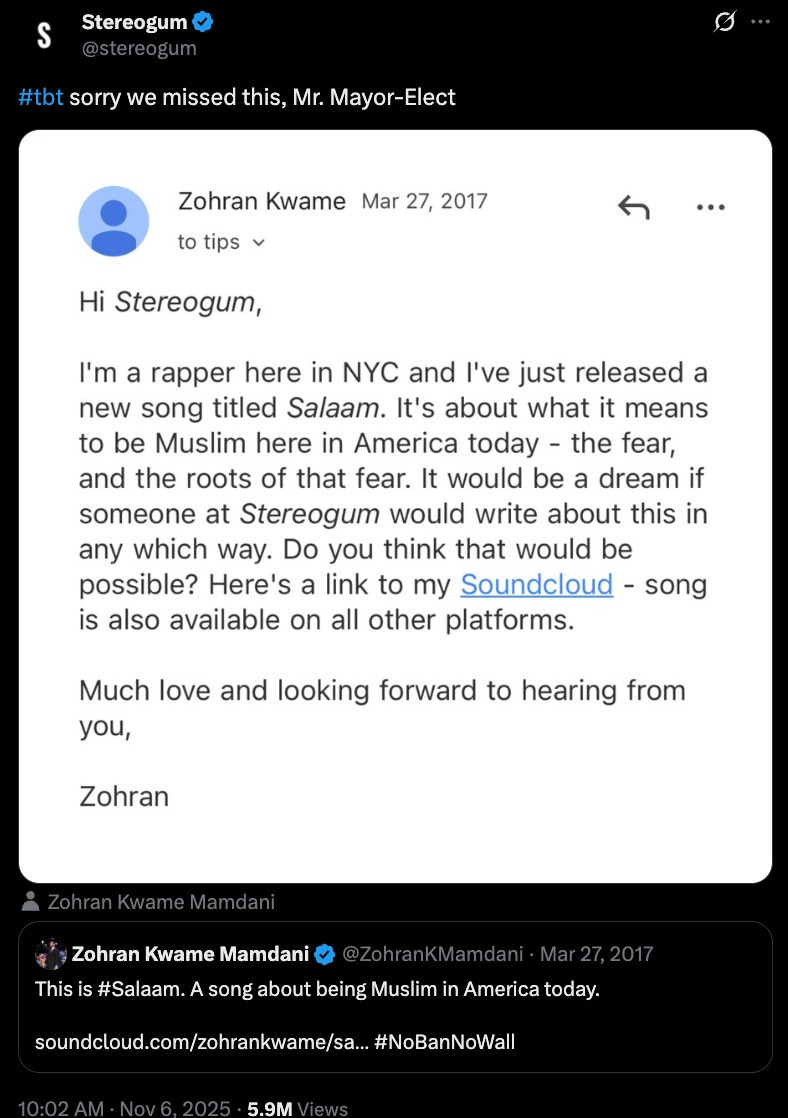
After his win, I feel comfortable writing about the most famous brown rapper/politician in American History. It’s easy to joke about the rapping or focus on his political skill. I wanted to take a different tack, focusing instead on the media culture of this eraand how Mamdani represents a particular admixture of Muslim, South Asian, leftist, and online values that isn’t immediately obvious to a general audience, but is clear to me. (This will likely take two posts, by the way.)
But first, the rapper policy.
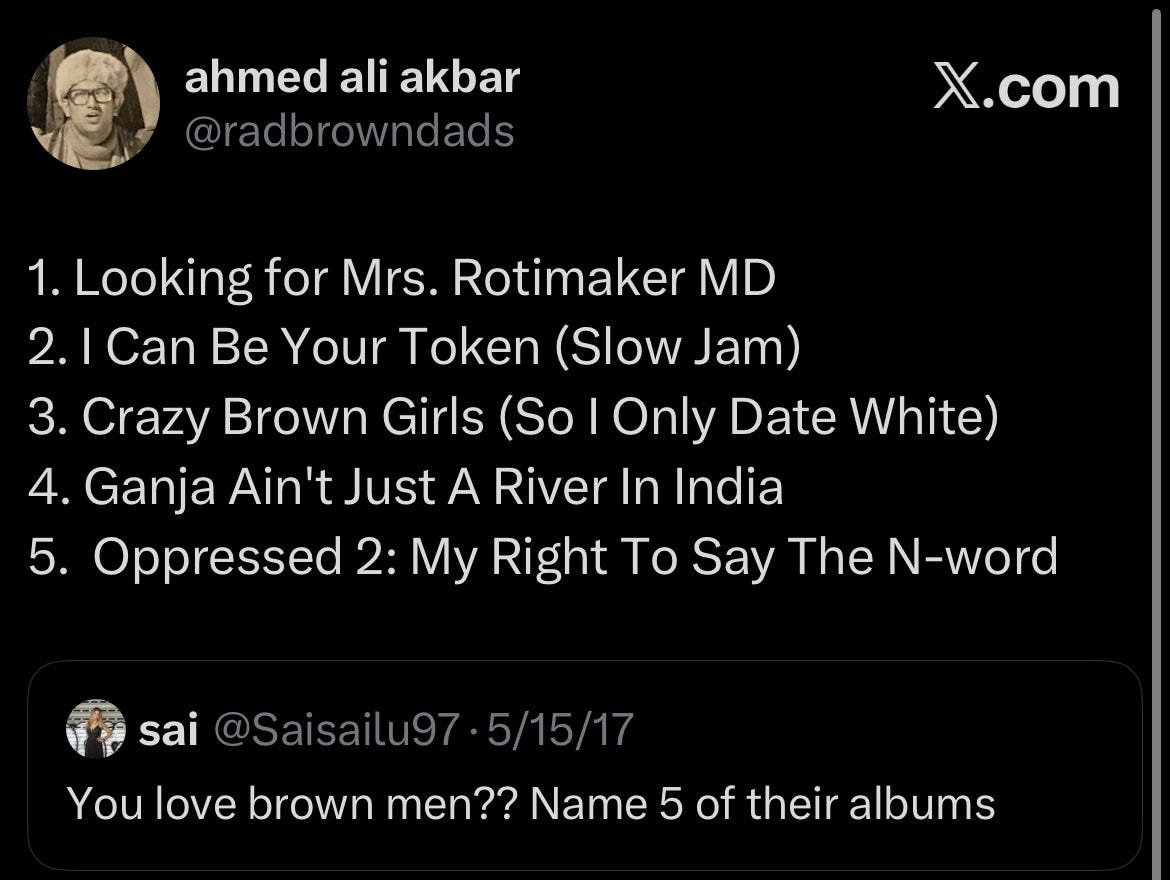
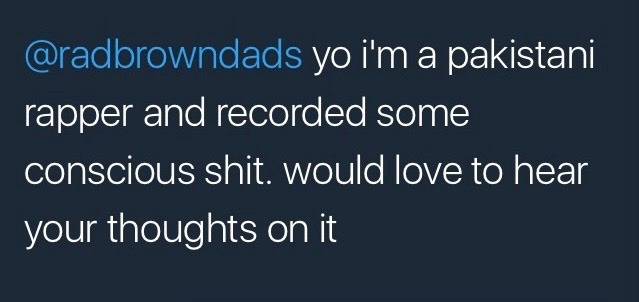
A rejection to a DM should be easy: I’d congratulate the rapper and decline to interview since I don’t cover music releases. This continues to work as a strategy for the messages I’ve received from self-promoting Muslim CEOs, comedians, or activists looking for press. But not for the rappers; they’d double down on their offense and persistence. As if their SoundCloud was a generational event that would change everything. Just give it a listen, they’d plead.
To my mild shame, I have listened to quite a few brown rappers. Some of them are my closest friends; I am, perhaps, the only member in my generation of male-identified cousins who hasn’t recorded a hip-hop song or dabbled in freestyling. But personally, having seen one too many become, let’s say, a little comfortable, I have a generalized discomfort with the genre.
I sensed that that I was a mirror for these brown rappers. They could, and sometimes were, my brothers and sister. On their end, seeing a platform like mine that was dedicated to American Muslims, they probably felt I was obligated support their art. Rather than delve into the muck, I started leaving them on read.
They still kept messaging me.
Later on, I started to also think I should stop come up with a policy of how to cover Muslim or brown politicians. This came to mind when Mamdani was running and I constantly had people asking me to cover him.
One of my earliest stories on American Muslim politicans was in 2017, during the midterms. Reporters Talal Ansari and Hannah Allam did a great story about how American Muslims were getting more civically engaged and running for office. This was a good basis for a story. But ultimately, I’m a culture reporter. I didn’t want to report on politicians because they were Muslim, just like I didn’t want to report on rappers because they were desi.
There’s no shortage of things to analyze with Mamdani on a culture level, from his usage of food to his support of taxi drivers. Politically, as a Democratic Socialist, he’s been remarkably focused on his core policies. While he engages deeply and effectively with the Muslim community, he also has a cosmopolitan, cross-cultural focus that makes him difficult to put in a box. And still, he does come out of a certain milieu that is parsable to me.
In 2025, I met Mamdani for the first time, completely on accident. I was returning to New York and happened to attend a Ramadan event my elder sister hosted. She told me Zohran was expected to attend briefly. He was, at this point, very much a long shot to be Mayor, but there was plenty of excitement amongst my peers.
Around the time Zohran arrived, I was sitting with a friend I hadn’t seen in years, catching up and putting my foot in my mouth with details I’d forgotten about their life. Overall, typical, lovely iftar. My sister waves me over, mouthing “come meet Zohran.”
I really did not want to work the night as a journalist; I wanted to simply be a literal uncle that evening, enjoying the spirituality and connection iftars bring.
I brought my half-eaten plate, head low as if being introduced to a distant relative, and sat on the floor. Zohran had his own plate, atop a plastic tarp, the exact setup used in my own mosque in Michigan. I introduced myself. He introduced himself. There was a pause. I realized, this is a campaign stop and in his eyes, I am a potential constituent.
“Oh, I’m a journalist. I used to live in New York until I moved to Chicago for my wife’s work.” A beat. I wasn’t sure what to say. “We’re very excited about your campaign.”
He lit up a little. Pauses. Asks me to say my full name again.
In the texts I sent after that night, I quoted him as saying, “No way. I’m a huge fan of your work! You should’ve said Rad Brown Dads!”
The interaction was fast and disarming, he lit up with his warm smile.
I thought, damn, this is a good politician. And I laughed a little.
I went home, kept tabs on his campaign.
Then, from Twitter, I realized, he was the rapper, Mr. Cardamom, and my world tilted.
In this time period, there were a lot of brown rappers out there and only a few broke through. Anik Khan. Big Baby Gandhi. Nav.
But I distinctly remember Mamdani’s “Nani” video. from 2019 It stars my own personal cooking icon, my Tony Bourdain or Julia Child, Madhur Jaffrey. Before she was the most influential Indian cookbook author in the West, she was an actress. Mamdani utilized that little known fact to great affect, subverting the box Jaffrey had been put in. Dare I say, it had a bit of Rad Brown Dads in it?
When I saw the video, I had no idea who Mr. Cardamom was, but I was curious what his next video would be like. It never happened.
So I go to DM Zohran to tell him that I actually was a fan of his too, I just didn’t know it at the time.
And I found this: a DM from Zohran asking to cover his proverbial mixtape from 2017.
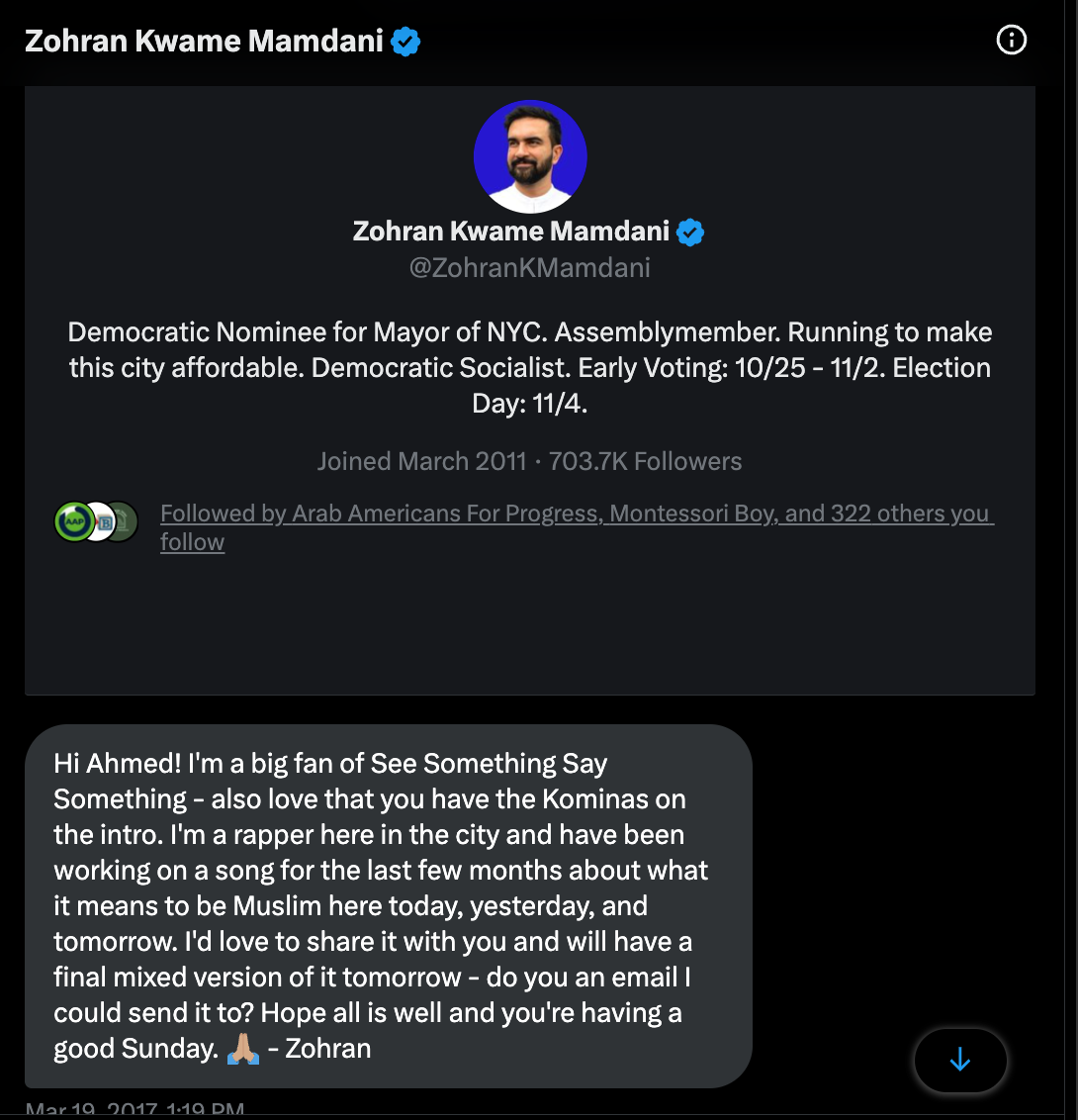
I even remember the name Zohran; it’s pretty uncommon for a Muslim. The message was nice, thoughtful. But! I don’t respond to brown rappers. Silence on my end.. You’ll notice Stereogum got the message after I received it.
He also mentions my podcast's house band, The Kominas. One of their songs, “Disco Uncle,” might as well be a distant relative to “Nani.”
I didn’t share the message much, except in one notable instance: Meg Cramer of the Pod-Squad, my favorite team of audio producers to ever exist, messaged me.
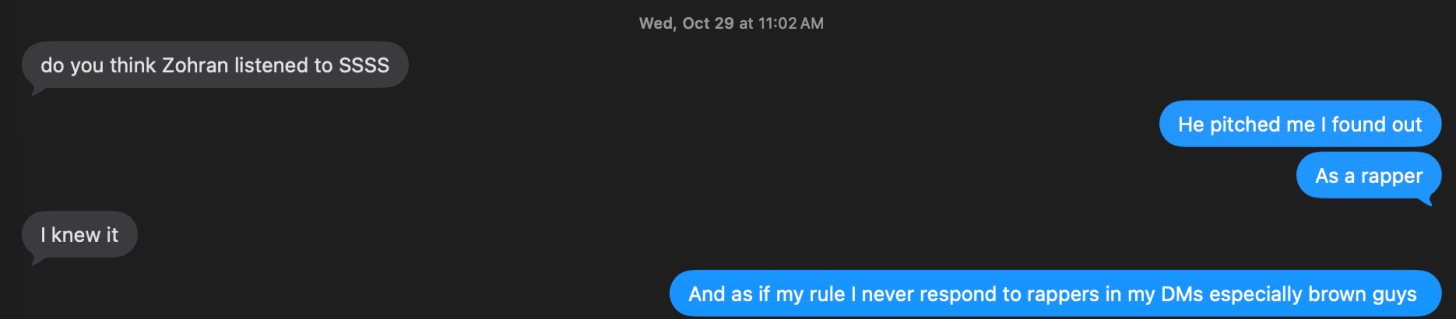
Now that the initial hype is come down, the DM is remarkable for a variety of reasons.
First, it’s incredibly funny. Second, it shows a remarkably consistency from Zohran. He could’ve easily name-dropped that he was the son of Mira Nair and Mahmood Mamdani and he would’ve known that would pique my interest. His mother directed Riz Ahmed in The Reluctant Fundamentalist! Not to mention, broadly speaking, Mississippi Masala and “Good Muslim, Bad Muslim” were frequent touch points in the 2010s amongst desi, Muslim, and culture writers.
But no, Zohran wanted to be known as a “rapper here in NYC.” I have to respect that, even if I’ve been less than respectful of brown rappers.
The majority of analysis has been about Mamdani’s politics, the Islamophobia he faced, the hope he brings, his food choices, and the repudiation of ineffective Democratic strategy. He always redirects towards his policies: free transit, rent stabilization, transparency, and deep love for the working class of the city.
But for me, it’s clear from his parents that he was given the tools to complicate typical narratives of South Asian or Muslim immigration. In a later piece, I’ll explore their work. But for now, it’s worth saying that Zohran Mamdani comes out of this kind of proverbial soup of alternative desi, Muslim media that formed people like myself and others. His type was known to us, even if it’s still being exposed to the world now years later.
II. A mini-review, Lilo & Stitch
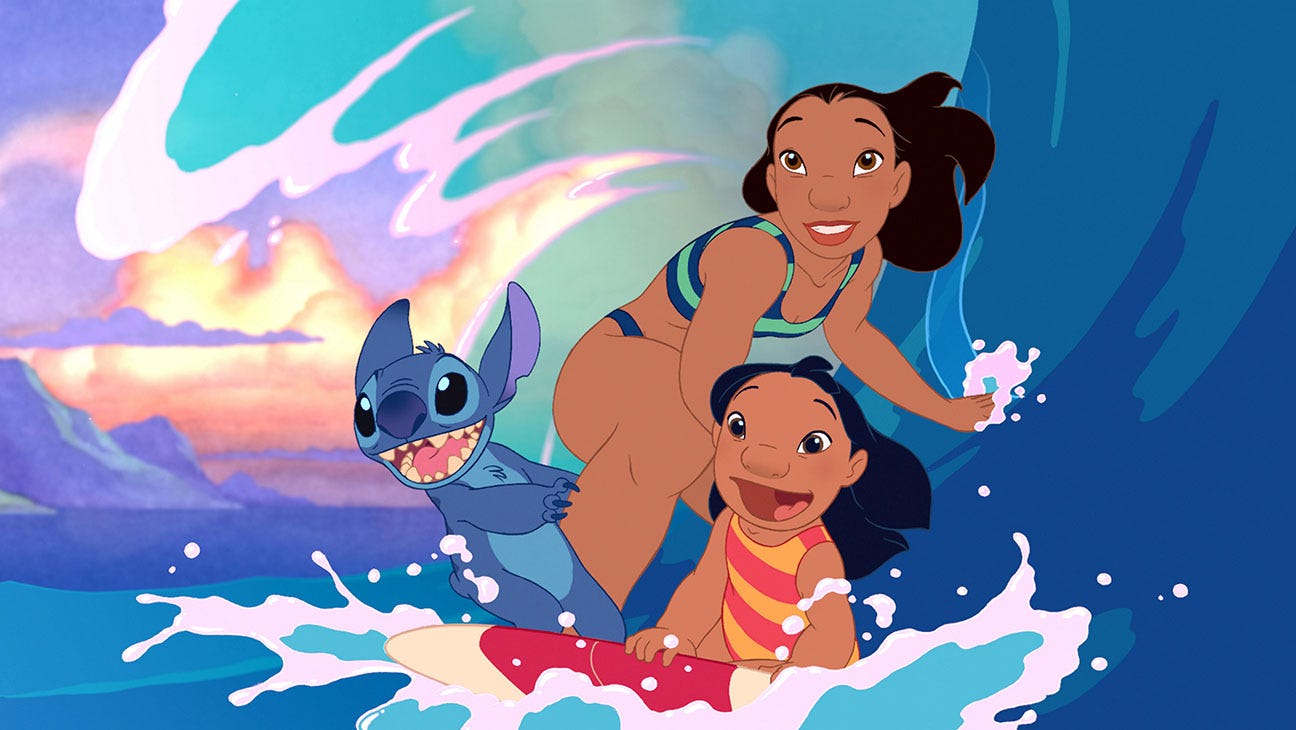
Lilo & Stitch was not a movie I watched when I was a kid, but I’m stunned by how odd it is in the Disney Renaissance films. Frankenstein. The Ugly Duckling. Elvis. Hawaii. Family separation. Queer aliens. Found family. It’s all in here. It’s a bit of a mess but I do appreciate it. My daughter loves it so I have to watch it so many more times. She unfortunately likes the considerably uglier sequel even more, which she has dubbed “Cousins.”
III. RBDining, preview
It occurs to me that I should write a bit about food, given that’s frequently been a career of mine. Next time, I’ll come more prepared.
Two restaurant restaurants Mamdani has name-dropped on his campaign are important to me personally. Abuqir, an Iskenderi Egyptian seafood in Queens, is actually my favorite food experience in the city. No menu, just a wall of ice and raw fish. I pull up to the counter and have my buddy Ahmed Hozain order in Arabic if I can. If he’s not there, I ask for tips on what to order, usually ending up with a whole fish, garlic-y shrimp, fried calamari, and salad with tahini.
The other restaurant Zohran has really talked up is Kebab King. I’ve got intense food memories of Dera, nearby, so I haven’t eaten it much.
But Kebab King is notable for having the most iconic jingle ever. I pitched a story about this jingle many times. No one has taken me up on it. Editors, I’m here. King King Kebab King.
IV. Lastly, Menswear
I believe in finding a few aesthetic spaces you enjoy and experimenting in them.
For me, this is taking inspiration from Midwestern and Pakistani historical fashion and specifically playing with tailoring, workwear, color, patterns, and denim. Carhartt, as I’ve mentioned, speaks specifically to my story of Michigander-in-the-East-Coast. Where Levis runs Cali/NY and Wrangler is Texas, Carhartt is the Midwest. It’s stolen valor sure, but jeans were workwear first.
Unfortunately, Carhartt is very popular now and has become expensive. For me, there’s no replacement. But recently, I realized, if you’re looking for vintage items, there are always alternatives. Every American region had local clothing manufacturing and many had shuttered. But, for instance, a vintage Carhartt jacket might be priced over $200, but the equivalent item in a vintage Dickie’s or LC King might not have that.
All this to say I’ve been on the hunt for a short, warm wool jacket this winter. Generally speaking, this would mean the Filson Mackinaw Cruiser, made of an absurdly heavy and durable wool. The company claims they patented it in 1914.
It’s outside of my aesthetic space and kind of hiking, PNW, lumberjack aesthetic I’ve never been able to pull off. The fit on modern Filson’s is atrocious. And it’s become absurdly expensive.
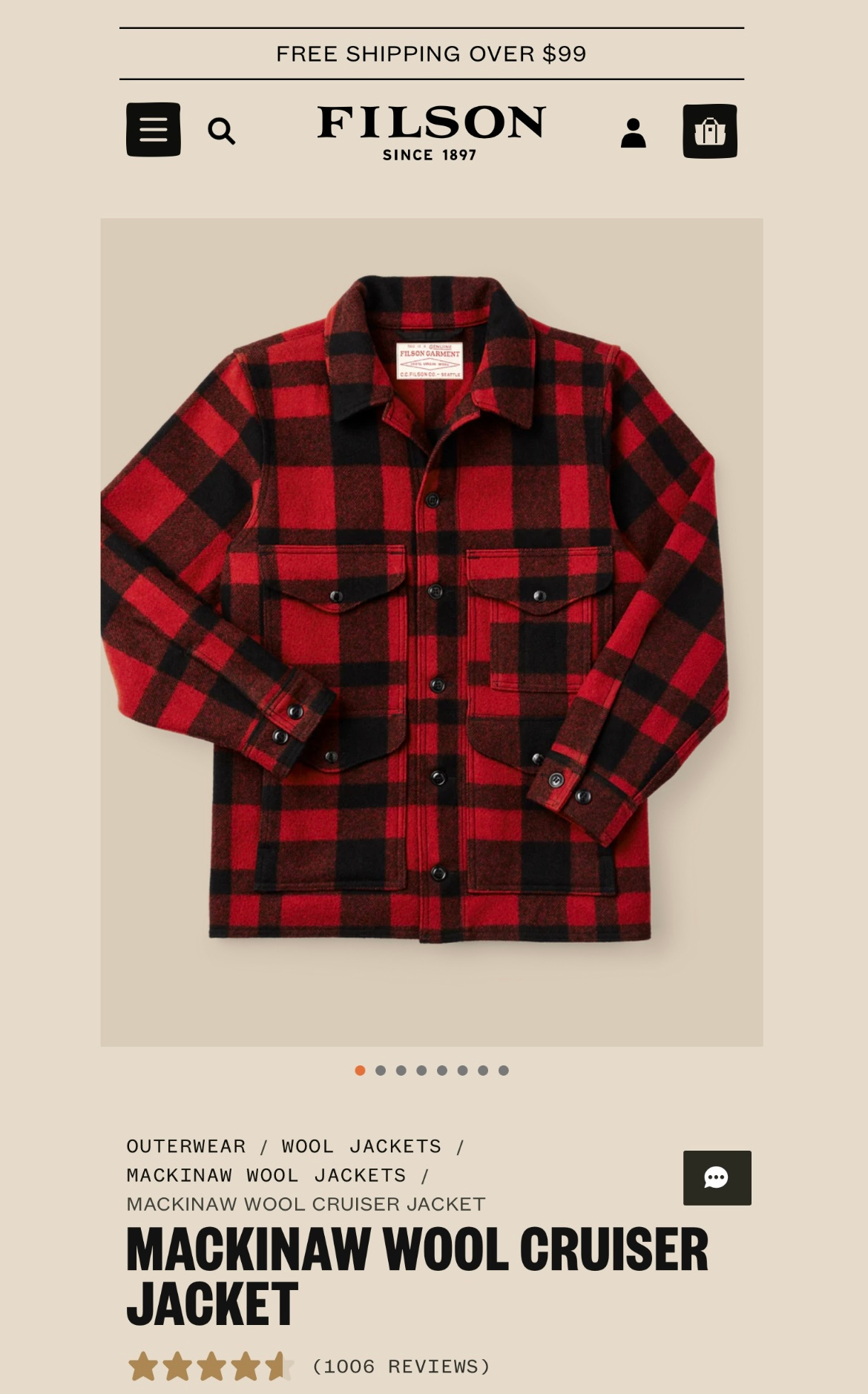
So I never really seriously considered it. MAYBE in olive green.
So imagine my surprise when I walk into my favorite local vintage shop and find a perfectly fitted buffalo plaid jacket that I actually like.
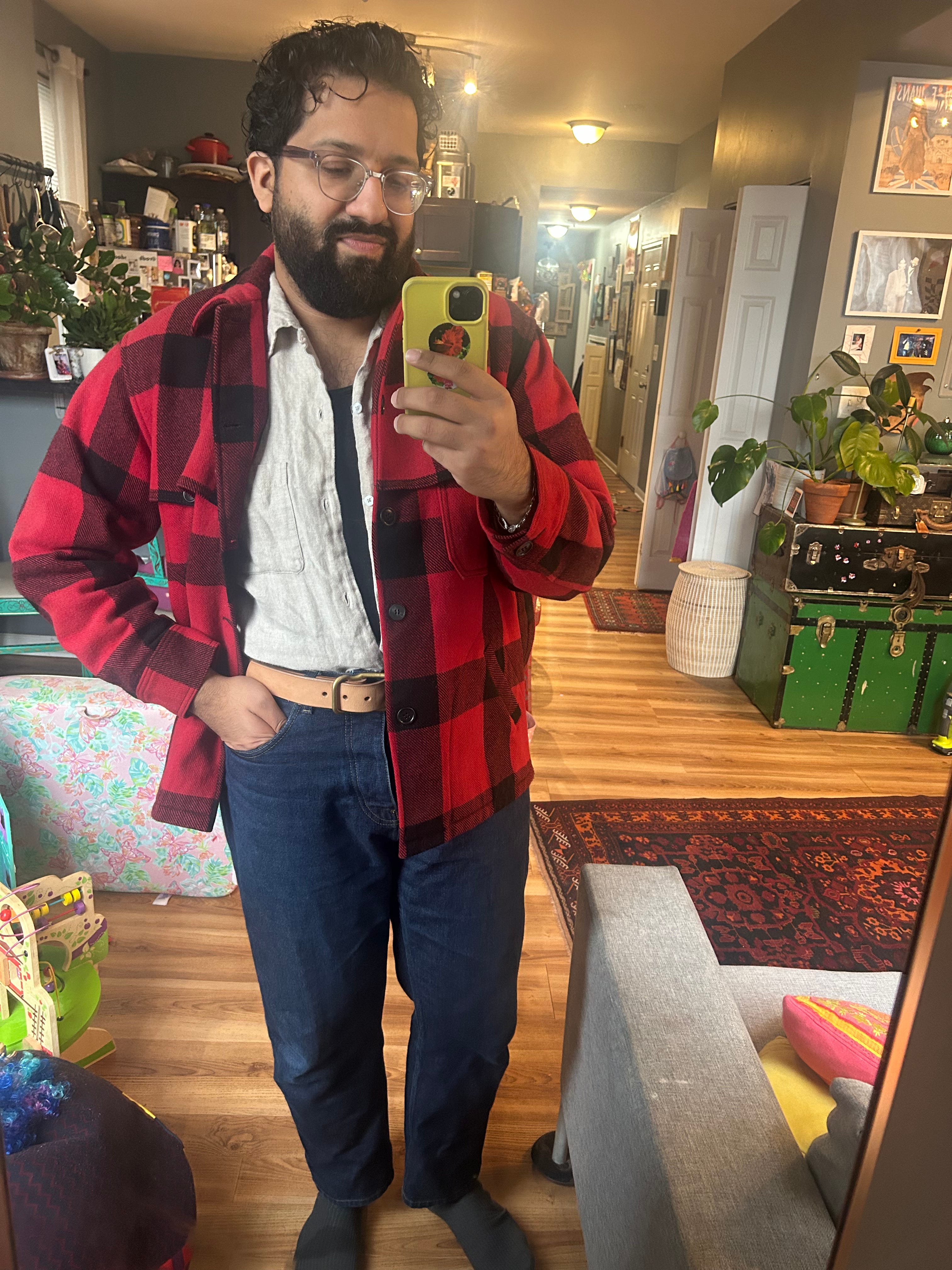
It’s not Filson, but Bemidji Woolen Mills, which has been operational in Bemidji, Minnesota, since 1920!
I went on eBay to find other colors, since buffalo plaid wasn’t my thing. I found the perfect one, in orange (!), and sent a low bid. It was so offensive to the seller that they banned me from purchasing it. I ended up going back and picking up the Bemidji cruiser.
Since to me it’s a bit Western-y, I decided to try the “Ralph Tuck,” popularized by Polo designer Ralph Lauren. I’ve never liked the Ralph Tuck, since it feels like taking someone’s personal style move and smushing it into yours. While it kind of works, I decided I’m never doing it again.
Til next time.
“I really did not want to work the night as a journalist; I wanted to simply be a literal uncle that evening”
I love your writing Ahmed :)