
Blacklisted: the underground scene of a competitive, fan-made game
Rivalries and legal threats: the Super Smash Brother's mod Project+ survived because its players and organizers refused to quit. I went to Blacklisted 9 to compete and tell a part of that story.

Everyone is a gamer.
Listen close to the twinkling, curious sounds of Wordscapes on your parents’ phone. Ask your aunt about how long she’s been playing Candy Crush. Or check how often your friends post their Wordle or Duolingo streak. Our lives have been irrevocably gamified.
But what makes someone a competitive gamer? I spent many teenage hours playing Super Smash Brothers Melee or Street Fighter, jockeying for the title of the best in a room of friends, family, and even strangers. Those moments in arcades and basements were formative for me, full of joy, annoyance, and determination. But while many of my friends stopped, I’ve been entering, spectating, or practicing to play fighting games at tournaments consistently since I was 14 years old.
Competition can be uncomfortable depending on how it manifests, but for me, it’s an important form of communication. I learn deeper insights about a person’s psychology. Last year, I joined my family’s New York Times Connections and Mini-crossword chat. For now, I still hold the family record of 9 seconds on the Mini, but I know my cousin Maha is hungry to defeat me while others think that I’m cheating by doing it on a keyboard. Other family members are absolute monsters in games like Urdle or Worlde and there, I am hopelessly outclassed.
The essence of competitive gaming is all around, if you look for it.
In my own main competitive game of Project+1, I still have a lot of growing to do. I’ve never been a top competitor. My mentality is mostly about self-improvement; it’s not about beating the other person as much as it is about performing at the highest possible level with the least possible effort. I did get ranked 13th in the state of Illinois earlier this year. I’m pleased with many of my accomplishments, but I resist the practice needed to improve as others have. I balance my ambitions there with others, including writing.
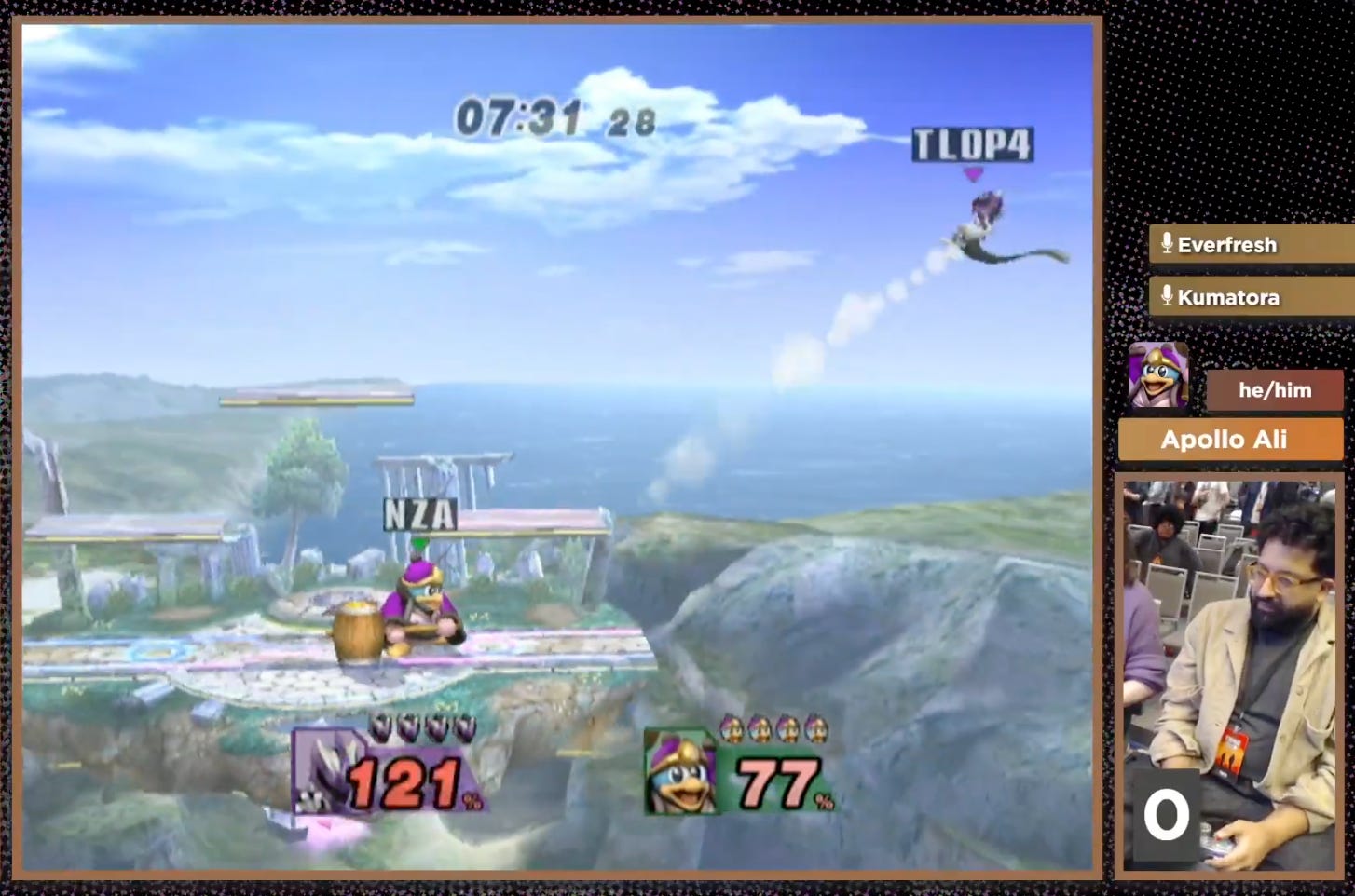
I have a romantic view of competitive fighting games, where two individuals meet on the field of battle and through gameplay, telling their narrative to an opponent and the gathered crowd. But beyond competition, there’s another story I’ve witnessed: of grassroots organizing and strategizing to avoid the attention of Nintendo, a rare video game company that has had no qualms aggressively using copyright law to threaten action against their own fans.
Earlier this month, I was standing outside the ballroom of the Waltham Westin Hotel in Massachusetts for a Smash Brothers tournament called Blacklisted 9. I had pulled aside Malachi “RBD Malachi” Covington, a friend whose player psychology has been an object of deep interest for me over the years.
In 2019, Malachi was ranked #1 in the world. Now working as a property manager from Harlem, he has been retired from competition for a few years, but decided to return for Blacklisted. We had both came to compete, but also to witness the final entry in a tournament series that defined a scene.
During our interview, Jonas “Yuko” Harrison interrupted with a shout and a light tap on the shoulder.
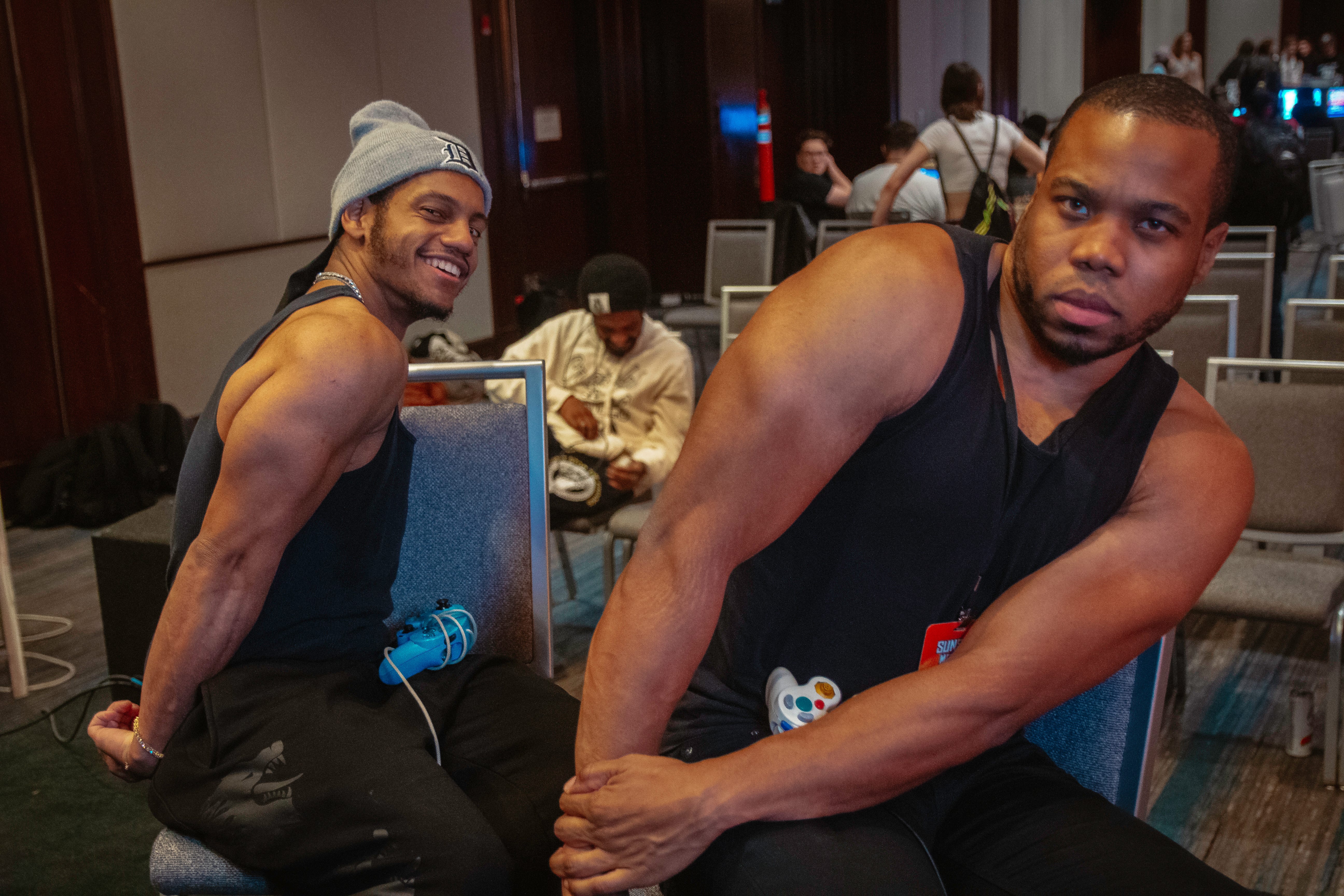
“Oh no,” Malachi said, just quietly enough so only I could hear. He had beaten Yuko solidly the day before, but disqualified himself afterwards due to an onset of hand pain induced by years of competing.
“Bro, I’m pissed!” yelled Yuko, clad in an impossibly fresh pair of bright-red overalls emblazoned with Super Mario. “We could’ve had the Black Meta Knight ditto!” gesturing from Malachi to Jabriil “Krumpberry” Abdulkadir Ibrahim. Read: we know you’d probably beat me, so if you were going to quit after, you should’ve let me keep playing! It’s not the first time an interaction like this has happened between the aloof New Yorker and the energetic Detroiter.
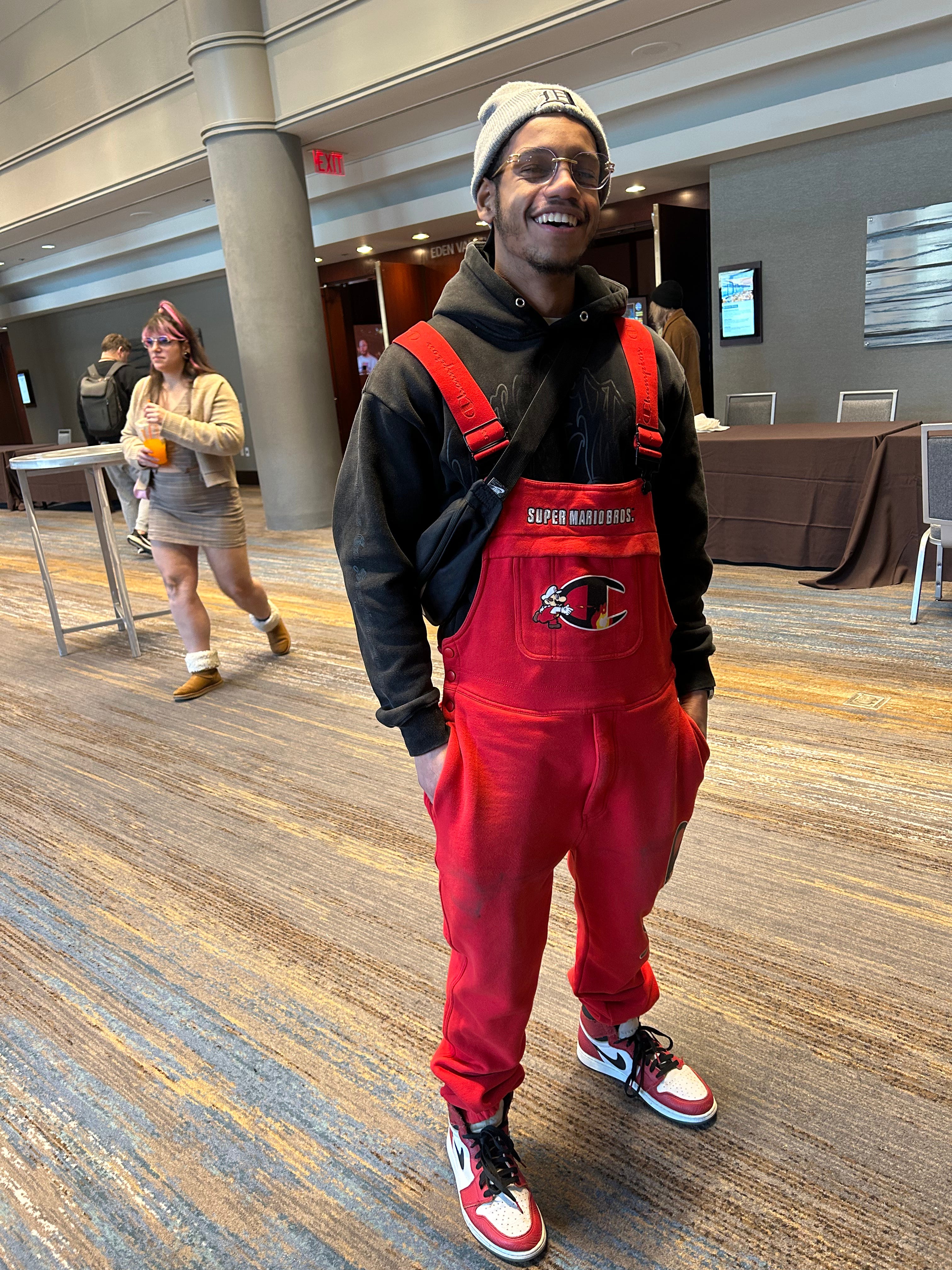
When Yuko realized he had interrupted us, he apologized. But I told him: keep going, this is what it’s all about.
Competitive gaming thrives on rivalry, on passion, and on trash talk. And yet, it also builds bonds and understanding that extend beyond the game.
Fighting games like Smash Brothers and Street Fighter still utilize the in-person, head-to-head format that first began in 90s arcades. In many major cities, tournaments are held at bars and LAN cafes weekly for all sorts of games — the Blacklisted series arose out of a weekly tournament called Smashing Grounds, which my first cousin, Nyle “RBD The NZA” Usmani co-founded.2
When the first Blacklisted was held in 2015, it was an innovative idea — to host a national-level tournament exclusively for Project M, a fan modification of Super Smash Brothers Brawl. The NZA was one of the lead organizers for the first Blacklisted and I was in charge of organizing livestreamed commentary.
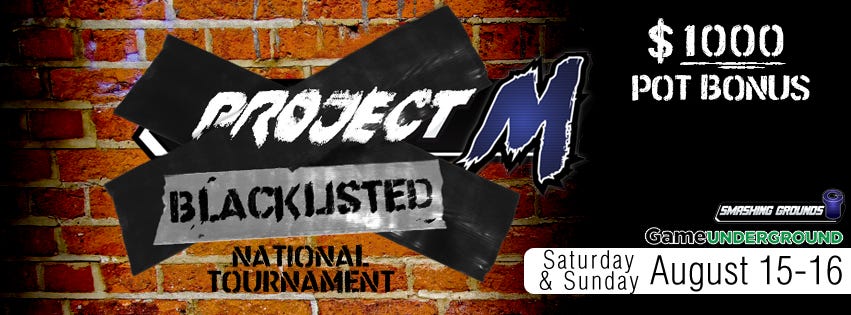
“It’s a miracle that any tournament ever happens,” said The NZA. “I would say organizing tournaments for video games, especially these types of games that aren’t money makers, it’s completely out of the love of the game.”
Still, Project M deserved better.
Project M began development in 2010 and the first full release, 3.02, released in 2014. Developed entirely for free, a group of programmers, designers, artists, and more modified the game to play faster and more like Super Smash Brothers Melee on the Gamecube. The competitive scene of the modification continues to host more tournaments with more entrants than the original game, Brawl, and has cemented itself as arguably the most popular console mod of all time with millions of downloads and hundreds of tournaments.
Typically, when gamers organize tournaments or develop fan projects, publishers and developers offer some level of support or tolerance. That never came for Project M, unlike other mods such as Counter-Strike, which went on to become one of the most important esports of all time.
In 2014, The NZA and I (“Apollo Ali”) travelled to Apex 2014, the first major tournament for 3.02. It had nearly 400 entrants, beating every other official Nintendo release besides Smash Brothers Melee.
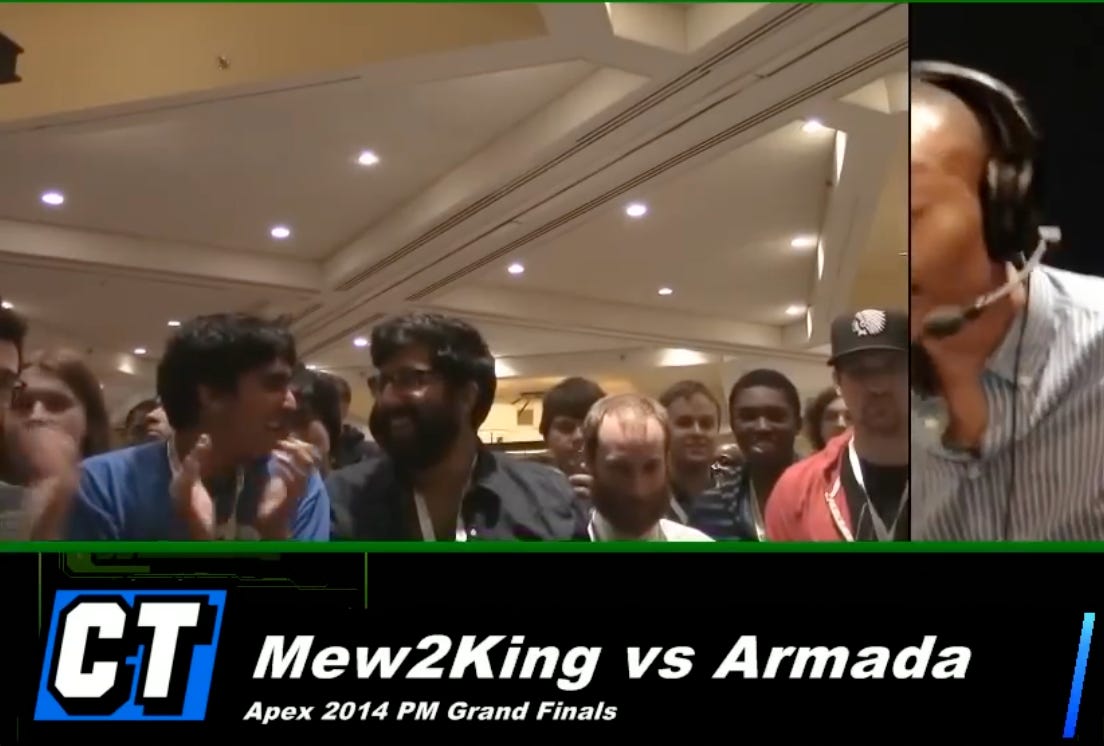
“[Project M] was built by the fans,” said The NZA. “It was essentially part of that DIY, remix culture of people who are fans of video games….building new games and new mechanics out of existing games” In that same vein, he was inspired to build a community locally, where he suspected there was a huge appetite for even more Smash.
In February of 2014, The NZA and his co-founders hosted the first Smashing Grounds weekly tournament. Within four months, there were over 100 entrants stuffed every Thursday into Game Underground, a small video gaming store in Framingham. Now, it’s hard to remember how absurdly popular this was. Tournaments would sometimes go long after midnight. Thousands of people sometimes watched our livestream on Twitch.
“Everybody was a dreamer [at Smashing Grounds],” said The NZA. People from all over New England drove sometimes an hour or more to compete. “(My job at the time) was a boring hellscape. I needed to find something to make my heart beat.”
The momentum felt tangible. It seemed possible that esports, Twitch viewership, and the expanding tournament circuit could build a real institution.
Despite this massive success, Project M was slowly, mysteriously being blacklisted, often without explanation, from influential events like Apex and Xanadu Weekly. They’d continue to hold tournaments for official games, but would drop or stop streaming Project M.
At the time, The NZA was an active poster on the online forum Smashboards and summarized the situation in an announcement post for Blacklisted.
“Many sponsors were under pressure from legal realities and a changing landscape guided by Nintendo’s example. One by one, they pushed for Project M to be peeled apart from this vibrant community.”
In that light, when their peers didn’t step in to help an embattled community, Project M tournament organizing came into its own . Blacklisted was likely the first Project M exclusive major tournament, but there were more. Over the years, many organizers picked up the torch, hosting tournaments like The Balcony in SoCal or the invitational, Project M Theater.
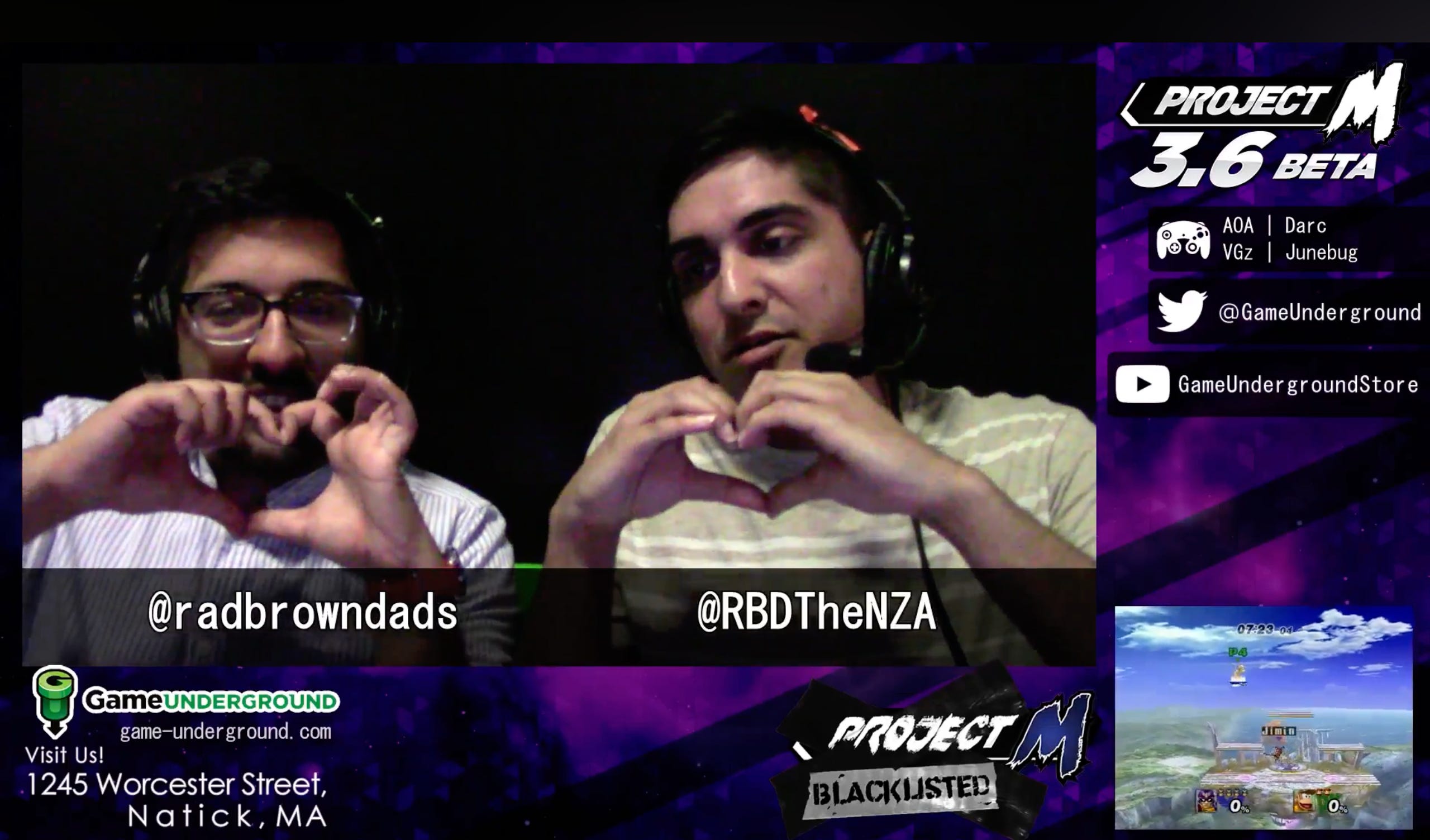
“We need to construct our own thing that can stand on its own,” The NZA remembers thinking. “As long as we’re reliant on others, corporate interests are going to ice us out. They’re going to scatter us into the shadows and we’re going to just die.”
In December 2015, the community faced another setback when the Project M Development Team announced it was ceasing development, for what has widely been speculated to be fear of legal reprisal. Eventually, a community-driven patch named “Project+” started releasing and continues providing updates to the base Project M experience.
The community did not die, even as the broader fighting game community treated it as an inconvenience or moved to protect themselves from corporate reprisal.
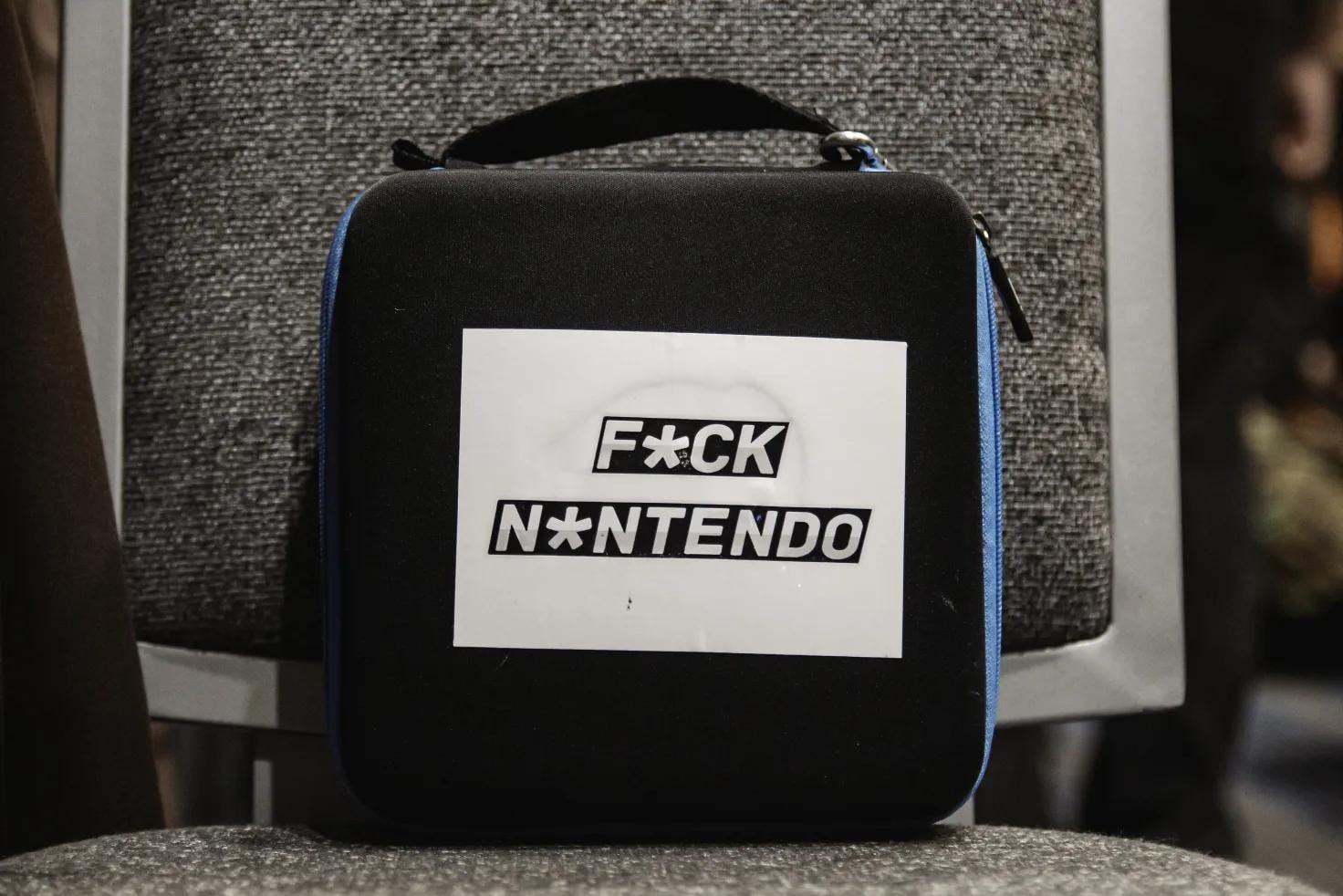
In 2021, Paul “Motobug” Canavan was working as a tournament organizer for Riptide, a Super Smash Brothers tournament held at the Kalahari Resort & Convention Center in Sandusky, Ohio. Riptide was going to have 384 entrants competing in Project+. That would’ve made it one of the top 5 biggest tournaments in the history of the game, nearly ten years after the mod’s release.
Unfortunately, it wasn’t meant to be.
“Two weeks beforehand, right before my birthday, a Nintendo email came,” said Motobug.
It was a cease & desist notice, specifically against Moto’s event, rather than the tournament as a whole.
Riptide’s official Twitter account announced they were contacted by a Nintendo of America rep and had to cancel the Project+ tournament and could not provide the game for players to casually enjoy at the venue.
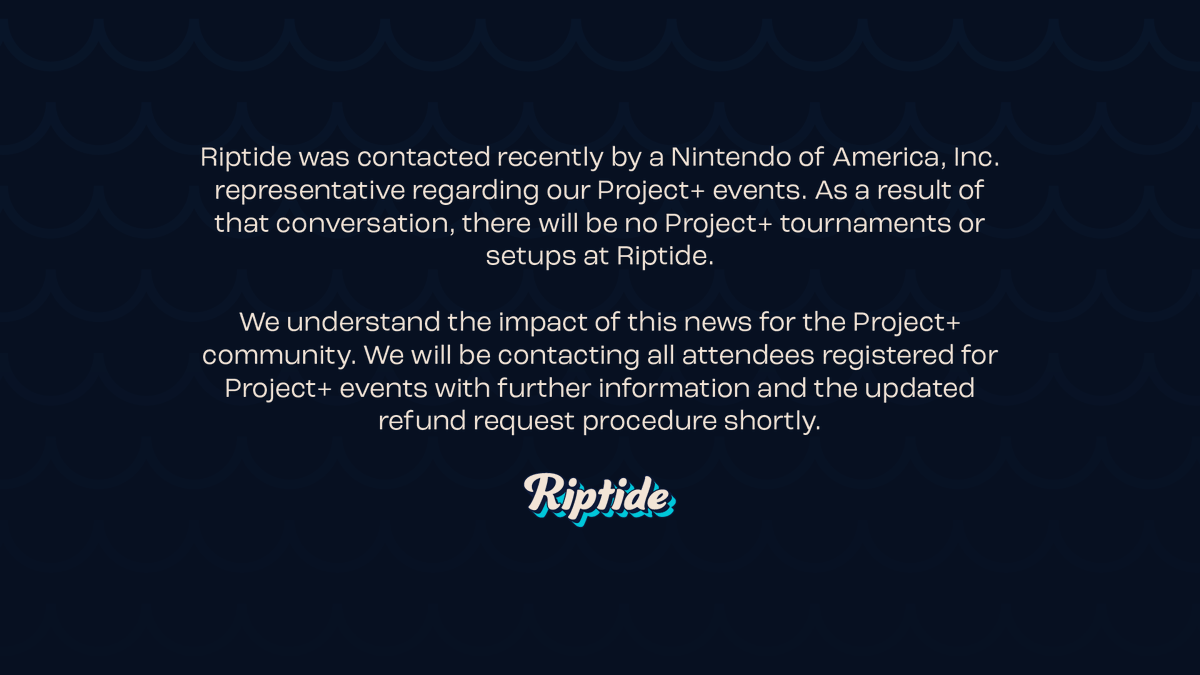
The community had pieced together why they had been targeted. Nintendo didn’t want a modification to be played next to an official game like Melee or Ultimate. Motobug and others ended up hosting a “shadow” tournament during Riptide, called Undertow, close enough that people could still attend both events while hopefully.
This year, Motobug announced that, after hosting Blacklisted since 2018, the 9th edition would be the final event in the series and Moto’s retirement from the work of organizing. The reasons were complex, but at least one factor was how often tournaments would have to face complications from their conflict with Nintendo.
“Obviously, having a community under attack all the time, even if it’s not constant, it’s a little stressful,” said Motobug.
Blacklisted 9 was also technically a “shadow major,” held in parallel to Sunset Melee’s official event. Motobug speculated that the community invented the term “shadow major,” since the Project M community is likely the largest gaming community that must actively hide their tournaments from the developer.
Blacklisted Forever
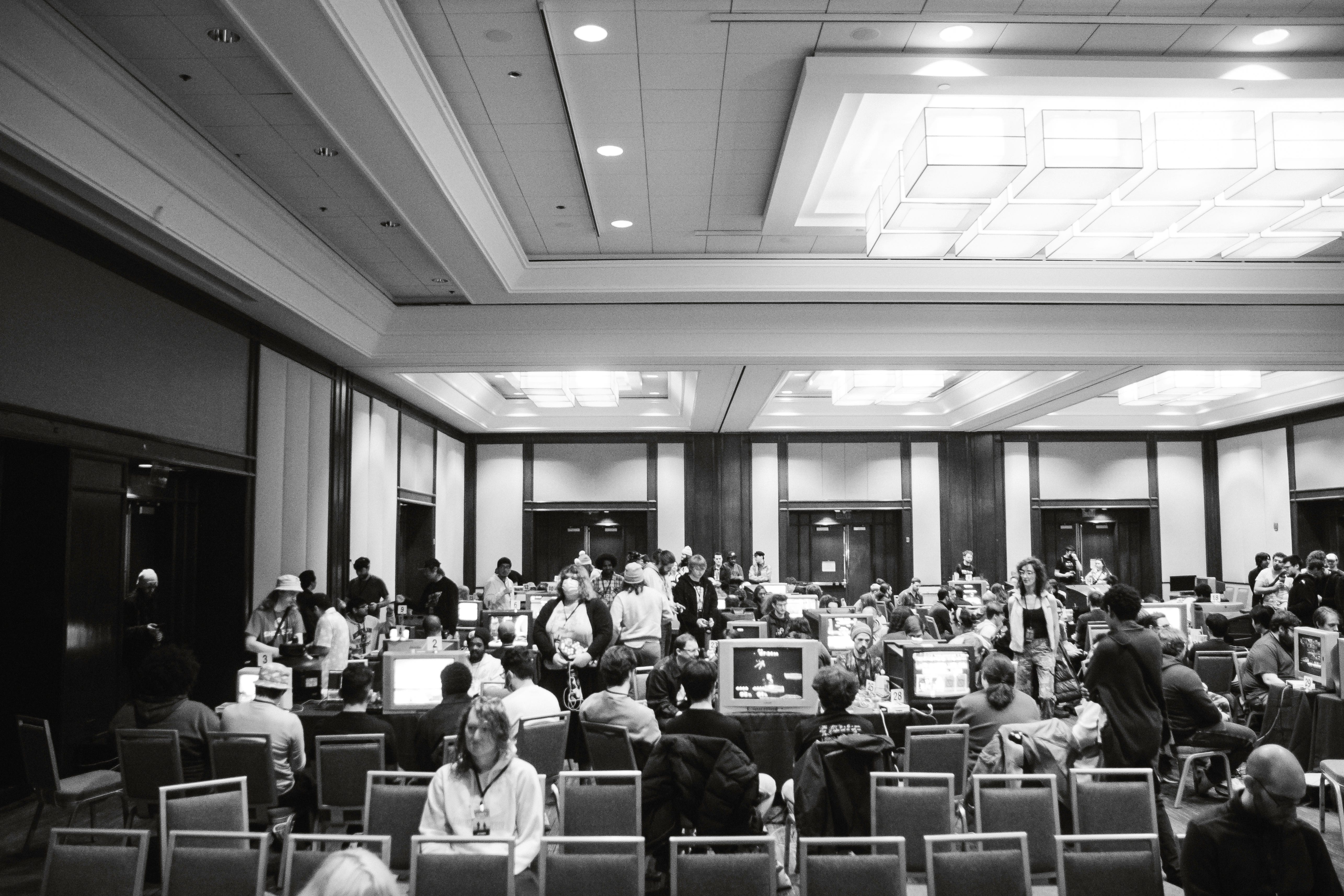
In the back of the hotel ballroom, competitors sat with Gamecube controllers in front of pairs of chunky, cathode ray tube televisions. In the front, there were two elevated stage areas, where a featured duo of players competed in front of a crowd and to a livestreamed audience. Things have come far from the Blacklisted 1, which was run out of a hot and crowded videogame store in Natick Mall.
Towards the end of the tournament, Motobug took the microphone to speak to the gathered tournament crowd.
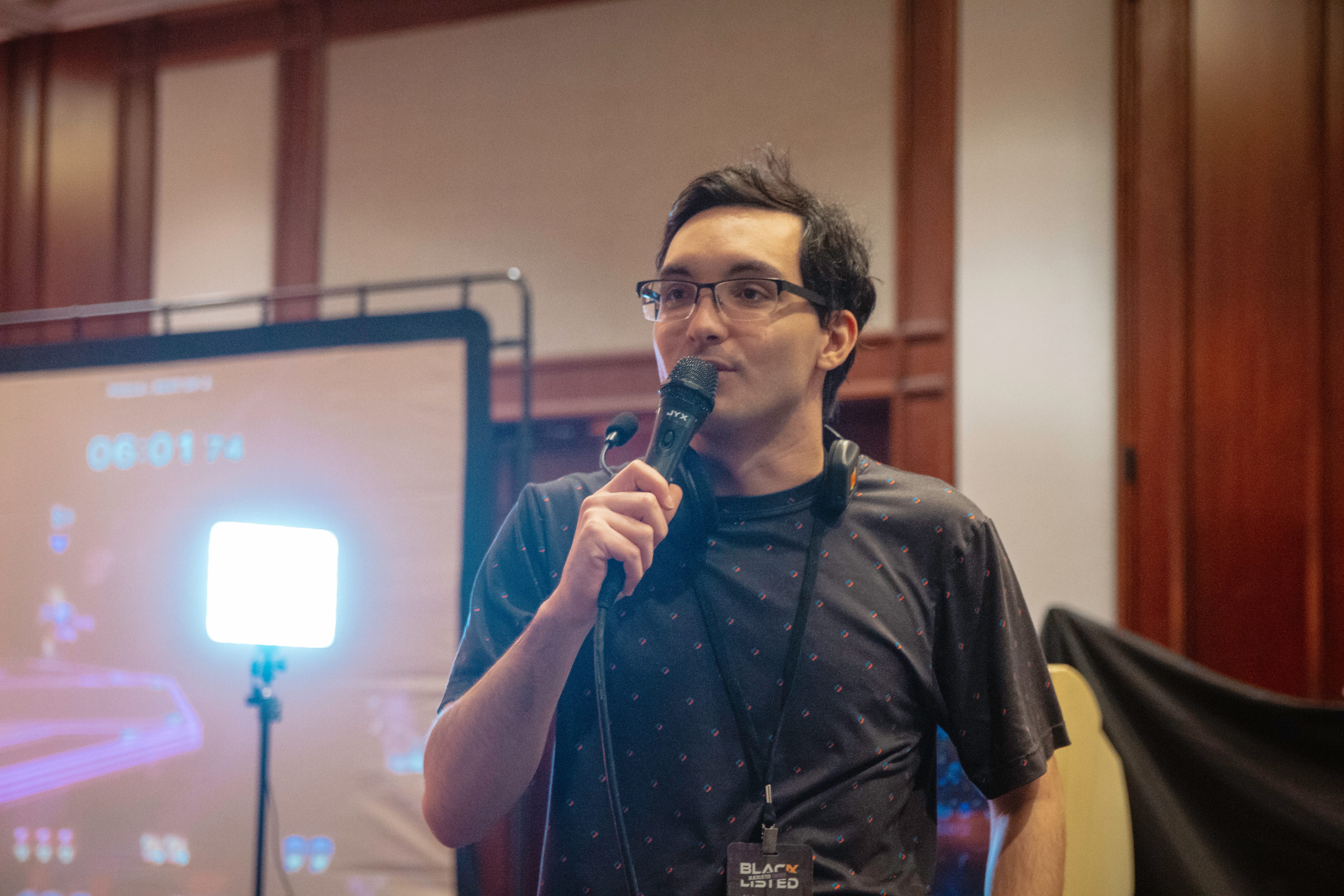
“You guys aren’t just my friends,” Motobug said. “You’re a family to me.” Tears welled in their eyes as the crowd cheered “Moto! Moto!”
Motobug, in a real sense, grew up in the scene, attending Massachusetts tournaments at the age of 14. Their background in a school band gave an early understanding of disciplined practice. They approached Smash the same way, through repetition and routine. Over time, Moto continued to grow as a player, earning multiple top-50 rankings. Eventually, they joined the development team for Project+. As their skills improved, that structure carried back into music, creating a feedback loop between the two disciplines. What began as practice and process gradually became something more personal.
“You get to express yourself,” said Moto. “It’s my own form of art.”
Leo “Comb” Curran also grew up in the scene. In 2015, he was twenty and had been regularly attending local events in Massachusetts. Blacklisted 1 was his first national level event.
“I was too shy to talk to these strangers even though we’re all here to play the same game,” he said, reminiscing about the first Blacklisted.
At the time, Comb was not known as a top competitor. In 2024, he was ranked 13th in the world.
“As much as it was intimidating, it really was kind of beautiful,” Comb said. “There’s really nothing like that feeling walking into that venue on day 1, seeing all the talent and knowing some crazy results are about to happen.”
He’s no longer the shy player; on stage at Blacklisted 9, he’d turn to the crowd and make gestures or yell back at his fans. At BL9, he ended up being the highest placing player to come from the scene that The NZA and Smashing Grounds started, placing 2nd.
“This game has always been about expressing myself and you’ve gotta be your own biggest fan,” Comb said. “When I was sitting down for Grand Finals of Blacklisted 9, my entire motivation was self fulfillment.
“At the end of the day, I was only playing for me.”
For Malachi, Blacklisted was an East Coast tradition.
“I consider Blacklisted to be my tournament,” he said. He’s travelled to Massachusetts for every single one since the second in 2016 and has won three, the most of any player.
I’ve played Malachi many times over the years and his complete precision and decision-making is terrifyingly cold and punishing. I wondered why he retired from competing when I still had the fire.
“I don’t think I’ve ever really been a competitor,” Malachi said. “I happened to be good at a game and liked getting better.” And when his hands prevented him from playing and attending tournaments became a struggle, he removed competitive gaming from his life. But the impact it made on his life stays.
“I haven’t been to a tournament in two, three years, and it made me kind of sad,” Malachi said to me. Most of his closest friends, he said, are people he met through Smash Bros in New York and New Jersey. That’s his community. But the relationships he built with people from Michigan, California, Boston, and everywhere in between feel more fragile, tied to the game itself, and to the events that brought them together. With his hand pain, his retirement, and with Blacklisted coming to an end, he knows some of those connections could quietly fade.
“We’re here for a game,” he said, “but I’ve grown to know these people through this tournament.”
After the tournament, I called up The NZA for this story and we reminisced about old times and the community he had helped build. He joked that the winner of Blacklisted, Rap Monster, was likely in elementary school when we started out. To his surprise, several old faces showed up for BL9, even if they had long since retired from competition.


“Looking at those pictures, it felt to me like everyone was coming back to sign their name on the credits of a movie that had been in production in 10 years,” said The NZA. “Everyone was in solidarity together but also identifying their place in the annals of history of this thing.”
———
One year ago, I wrote an essay about the Marvel vs. Capcom 2 tournament at Frosty Faustings, a Chicago-area tournament. That too, was a story of resilience. This year, I again plan to attend the tournament and enter MVC2, but there isn’t a Project+ event.
Why have I continued to enter these tournaments as my peers lose interest? Perhaps it’s because I’ve never achieved my goals. Perhaps it’s because of the community. But most of all, it’s the language of competition and what I learn about myself and others from the act of play.
Perhaps forever, we will be blacklisted. But we still fight for our name.
More about Rad Brown Dads here. Click here for more images by Joey Hogan from the tournament.
The game has had many names over the years and several are still in use, including Project Melee, Project M, PM, and P+. All of the above will be used by this article.
Other co-founders and historical organizers of Smashing Grounds and Blacklisted include AOI, Billz, GTown_Tom, Atlas, Mizuki, Baka, Kumatora, kate, Domlax, and more.